Archive for May, 2007
My wife has been reading a book by Gary McIntosh called “Beyond the First Visit: The Complete Guide to Connecting Guests to Your Church.” This is not my type of book, but she liked it and thought I’d enjoy the next to last chapter which is titled, “Don’t Assimilate Me” and is focused on the emerging movement. She was right because he had some interesting observations from the perspective of an outsider (non-emerging).
One of the first things the McIntosh did was lay out what he viewed to be the ten characteristics that, while all don’t, many emerging movement faith communities espouse.
- They see Jesus and the Sermon on the Mount as central to faith. Thus social and ethical concerns are just as important to them as spiritual concerns.
- They see God’s fingerprint everywhere. Thus there is no secular realm as such, but many, perhaps most, things in the secular realm are considered spiritual.
- The see community as more important than church. Thus community happens first, leading to church; rather than church happening first, leading to community.
- The see dialog as more important than debate. Thus they focus on building relationships first by stressing similarities, and work on differences after the relationship has been forged.
- The see hospitality as central to discipleship. Thus welcoming others takes place in the secular realm as well as in the church.
- The see worship as an authentic encounter with the living God. Thus prefab worship services are replaced with individual creative expressions.
- They see shared leadership as the ideal model. Thus gifted people are free to lead without constraint in a highly collaborative atmosphere.
- They see culture as organic – fluid, shifting, and dynamic. Thus spirituality, community, and faith must be elastic, creating an uncharted journey with unexpected detours, but always progressing.
- They see spiritual life as holistic. Thus spiritual growth and expression happen not just in traditional acts of devotion, but in all realms and activities of life.
- They see church as missional. Thus they see themselves on a mission from God to transform their world.
Using these ten characteristics, he then lays out a different paradigm of connecting the guest than that common to the Baby Boom generation. The following is almost verbatim including the language and terms he uses.
Sharing Compelling Stories
Emerging churches reject the use of formulas and simple solutions. The use of simplistic approaches to ministry, such as “The Four Spiritual Laws,” “The Roman Road,” or the newcomers’ class, are not welcome. Deep sharing of one’s personal story through intimate conversations is the preferred model to salvation, as well as assimilation. Connection happens naturally as newcomers are drawn into personal stories, the story of Jesus, and the story of the church.
Embracing People into the Community
Approaches that look or feel like they serve the institutional church are deplored. Since the church is a community of faith, the relational is highlighted over the institutional. Normally, traditional church expect newcomers to commit their lives to Christ and be baptized before they are embraced into the community of faith. Emerging churches often turn this around and accept people into the community before they are believers. Thus guests are allowed to serve and participate in church ministry and activities in the hope that they will embrace Christ in the process.
Doing Life Together
Emerging churches sense that advice given without request is rarely accepted, so answers to life’s troubling questions are not immediately dispensed as though from a “Bible answer man.” Doing life together allows life’s questions to rise naturally, and guests can see the truth of God’s word internalized in the lives of real people, as well as exegeted from the pulpit. As guests see God’s word lived out authentically in people, they are drawn to become part of the church.
Engaging the Senses
God’s propositional truth is valued, but emerging types desire to learn truth through all the senses. They find that art, music, poetry, media, Internet, drama, and lots of stories are powerful ways to engage guests and draw them into God’s story and the church’s story.
Learning Together
Communities of faith are learning environments where fellow learners gather to discover the truth of God’s word. In such a context pastors and other teacher must approach guest as parent-like mentors who have traveled further, rather than as know-it-all Bible teachers. Newcomers are drawn to connect with churches that treat them as fellow travelers.
Hitting the Streets
Understanding the basic facts, figures, and outlines of Scripture is not enough in emerging churches. Experiential knowledge that is acquired by seeing God at work in the lives of real people and honest situations is more meaningful. As guests see God’s truth evident in people’s lives, they are enticed to become part of the church. Thus helping newcomers get involved in the lives of needy people in the larger church community is a powerful way to connect them to the church.
Challenging the Culture
Emerging churches resist a blind acceptance of the predominate culture. They are drawn to churches that provide a biblical critique of the culture. This churches that seek to redeem the world as well as individuals will fined guests connecting with them.
When I shared some of the ten characteristics above with my non-emerging boomer “church” friends, it didn’t resonate with them at all. A blank stare was more common than not. I’m interested in your reaction and comments on what Mr. McIntosh has laid out here.
Popularity: 54% [?]
Technorati Tags: Emerging Church, Missional, Gary McIntosh
May 31st, 2007
Good short interview with Dan Kimball over at “Out of Ur” about consumerism and the church.
Popularity: 40% [?]
Technorati Tags: Dan Kimball, Consumerism
May 30th, 2007
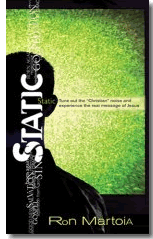 “The Ooze” Select Blogger Book Review
“Static” by Ron Martoia (Tyndale, 2007) is one of those books that will speak to the person who already knows the truth the author is working to relate and to those who have never explored this ground. For the former, it will refresh and invigorate the concepts. For the latter, it will open a whole new door of understanding.
So what is this book about? Its about how the words many Jesus followers use to describe their faith often shuts down spiritual conversation instead of enhancing it. Our language creates ’static’ and the author want us to learn to tune out the ‘Christian noise’ so both the Jesus follower and the not-yet-Christian can experience the real message of Jesus.
Although the style used in the book to communicate the message is not my favorite approach, it is effective. It takes the form of an ongoing dialog between the author and Jess and her husband Phil. Phil has been “sharing” with a Marty, a coworker. Seems Marty is now avoiding Phil and Phil can’t figure out why.
In the 241 pages, Martoia does a tremendous job exploring the language Phil and most Jesus followers use when talking with not-yet-Christians. Ron attempts to answer questions like “Why do people tune out the Christian message? Why are the words we use turning people off from the real message of Jesus? What if these words are causing misunderstandings about Jesus? What if we haven’t heard the whole story?”
To give you a taste, let me leave you with this line of thought from the book.
Martoia asks, “How many people do you know today who go around with feelings of guilt over their sin, over missed obligations, over offending God?”
Most people in our post Christian western world who are not followers of Jesus simply find no connection with the idea that they are sinners in need of a savior and therefore don’t connect with our “gospel.” “That doesn’t mean they are accurate in their self-assessment, but it does explain why they have moved on to other conversations,” say Martoia. Further, the author explains why Jesus dying on the cross for our sins so that we can go to heaven doesn’t even reflect the story that people in the first century would have understood when explaining the word gospel.
What’s the answer? You’ll have to read the book, but as Chuck Smith Jr. writes, Martoia guides “us back through original language in its original setting [and] brings us to a gospel that is a divine newsflash, as compelling today as it was in the first century.”
For those who read and enjoy Scot McKnight, you will also like this book. You can hear the echo of Scot throughout, who, not surprising, Ron credits as a major influencer.
Highly recommend.
Any of you read this book yet? If so, what was your take?
Popularity: 39% [?]
Technorati Tags: Static, Ron Martoia, Missional Church, Emerging Church, Gospel
May 29th, 2007
Just back from a long holiday weekend. This is our annual first trip out and we always camp at a local State park. Seven families this year and it is always a great time.

This is our camping outfit with my wife adding the beauty.
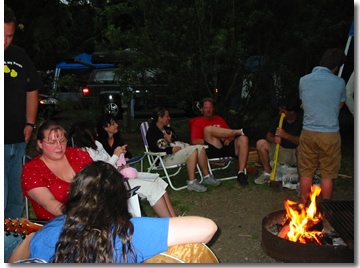
A bunch of us at the evening campfire catching up and just fun conversation.
Popularity: 33% [?]
May 28th, 2007
Been enjoying the time away from blogging and reading blogs, but I must admit that I’m missing the interaction and conversation.
Our family will be taking a long Memorial Day weekend (national holiday in USA) camping trip this week. There are three families we go camping with at least twice yearly and this weekend is always our first trip out. I plan to do some writing during this time including finishing my review of Static, so look forward to that being posted next week. Maybe I’ll post a picture or two also.
Popularity: 39% [?]
May 22nd, 2007
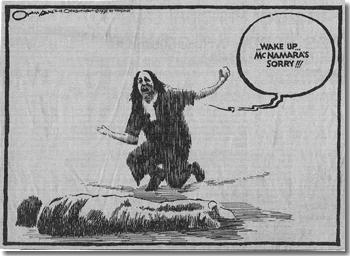
The Kent State massacre occurred at Kent State University 37 years ago today. Four students were killed and nine others wounded. Some of us have a hard time forgetting that your own government can shoot you down for voicing an opinion.
Popularity: 62% [?]
May 4th, 2007
Those of you who work at creating informative blog posts know that it can take up lots of time. And then there are all those other great blogs you want and “need” to read and comment on. But, as Scott McKnight once noted, most blogger have time to blog and read and comment on other blogs, but rarely both. The point is, it takes time that has to come from something else. Unfortunately, it often comes from the wrong place.
During my posting break I’ve been working at making time a number of activities that are necessary and important. I mentioned needing to get caught up on my reading and having been doing so. It has been a real fruitful time. My notebook is filling fast with good stuff from both Martoia’s Static (Tyndale, 2007) and Guder’s Missional Church (Eerdmans, 1998). Definitely some posts coming on this stuff.
But I have also gotten back to spending more time in the Biblical narrative. I’ve made it a point to do this at my local Starbucks. The change of venue has been surprisingly good and has made study much easier. I’m also back to making the 6:30 am weekly prayer time at our faith community. I miss this time of intense community prayer.
Finally, I’ve been free to so some other stuff like going out with our home group to volunteer last Saturday morning at Medical Teams International. This is a great Christian organization that, since 1986, has:
- Disaster: Responded to some of the most devastating and difficult disaster scenes around the world. Within 48 hours, they send volunteer medical professionals to natural and manmade disasters to care for the sick and injured. You name the disaster and they have had teams there within 48 hours.
- Development: Their volunteer teams and staff work to establish long-term solutions to international communities plagued by chronic poverty, lack of medical care and minimal educational opportunities.
- Distribution: More than $1 billion in medical supplies and aid has been shipped worldwide. They partner with 240 in-country organizations in more than 70 countries to ensure that the supplies are distributed economically and securely. Here in the United States, Medical Teams International annually disperses more than $1.7 million in supplies and products to a wide spectrum of social service agencies. In fiscal year 2005-06, they shipped $101 million worth of lifesaving supplies.
- Domestic: Their Mobile Dental Clinic program serves more than 15,000 needy people each year by partnering with more than 200 organizations, including schools, social service agencies and churches. Professional dental volunteers treat the homeless and uninsured in 39 Pacific Northwest (USA) counties each year.
What we did was unpack, sort, box and track pallet loads of donated medical supplies that had come in that week.
The entire organization has (I think this is right) only three paid staff. Everything else is done by volunteers – over 2,500 of them. The medical teams that go out, except for some special cases, also pay for all their own travel costs. I went on a similar trip to Ecuador back in 2001 (with a different organization) where we held clinics back in the high Andes Mountains. What an experience.
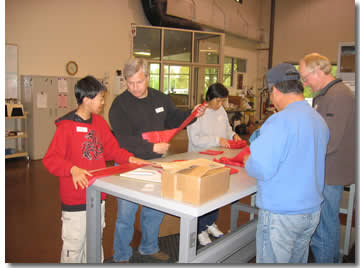
The pictured is part of our team. I’m the gray headed one in the black sweatshirt and jeans talking with the son of one of our other team members.
Here are some questions Medical Teams International challenged us with that I think are worth considering:
- What are my personal values and priorities? Do I need to change how I am living or what I am doing in order to improve the well-being of others, including the poor?
- What things should I stop doing because they are contributing to the suffering of the poor?
- What things should I start doing to help reduce the suffering of the poor in our world?
- How can I change my spending practices and priorities so that I can give more to help the poor?
- How can my church, my school, or my civic organization be more involved in helping the poor?
- What does the Bible say about helping the poor and living responsibly in our world?
- What are my real attitudes to the poor, to those affected by HIV/AIDS, to people involved in conflicts in other parts of the world?
Food for thought.
Popularity: 57% [?]
Technorati Tags: Medical Teams International, Missional, Missional Church
May 2nd, 2007


