Our faith community has been working to involve more and more of its member in learning to live the life of God in the way of Jesus, including becoming involved with our community in a variety of ways. One of the many ways this is being done is through our existing small group structure and an eight week study title “What Then Must We Do?” which was written by one of our pastors, Justin Ubel. Now the neat things about this study is that it is not all about more knowledge. As Justin wrote, “[T]he whole purpose of this study is not simply to talk a good game when it comes to following Jesus, but to actually do the things that following Jesus entails.”
What this means is that included in the study are group experiences where we find a community need and go out and get involved as a group.
We did our first group experience by volunteering at Northwest Children’s Outreach (NCO). This is an organization started and run by Jesus followers that provides resources to all children in need, from birth to age 18, regardless of religious, ethnic, political or other affiliations. They do this primarily by supporting over 60 not-for-profit and government agencies.
As they tell the story, these other groups work with at risk families on a variety of fronts and see the needs of the children. Meeting those needs may not be what their agency does or meeting those needs could distract for their primary focus. That is where NCO helps.
When a caseworker sees a need that can’t be filled through regular channels, he or she contacts our organization [NCO] and requests our help. We provide items customized for each family, clothing in the sizes the children wear, the health items they need, diapers in the correct size, the special formula a baby needs, according to the information given to us by the caseworker.
What our little group did was spend an evening pulling together all the “stuff” that goes into each customized requests and getting them ready for delivery to the various requesting groups and agencies. Those groups then make the actual delivery as part of their regular contact with the family.
Each “bag” contained very age (include newborns), sex and size specific items. NCO has a whole range of uniform “bags,” but I worked on clothing requests for middle school aged boys. I can’t recall everything included, but here is what I do remember:
Two regular button type shirts.
Two T-shirts.
One sweater.
One Coat.
Two sets of underwear.
One belt.
Two pairs of socks.
One pair of athletic type shoes.
One pair of “regular” shoes.
One winter socking type hat.
One pair of winter type gloves.
Two age appropriate books.
Two age appropriate games.
Two age appropriate toys.
A gospel of John.
Our group, along with other volunteers, did over 70 of these “requests” that night. It was a real good doing some of the things that following Jesus entails.
(This is a revision of a post that had such a short life, for it was posted just days before my December blog meltdown.)
When Jesus said, “Therefore go and make disciples of all nations, baptizing them in the name of the Father and of the Son and of the Holy Spirit, and teaching them to obey everything I have commanded you,” have you ever given any thought to what he meant? I don’t mean what you have been taught about what he meant, but what he really had in mind?
Having spent most of my formative spiritual years in a fine Southern Baptist community of faith, when this verse was read I’d immediately think of evangelism and not much beyond that. We were taught that what this “Great Commission” meant was to go and evangelize the world. This was all well and good, but it focused all our efforts on a transaction, on getting the conversion, on getting someone baptized. But isn’t there more to this charge than a transaction?
What is embodied in making disciples? Here are some thoughts that I’ve been journaling as I’ve meditated on this passage. I share them only to get you started on your own meditative work, for there are deep riches here yet to be mined and understood.
It will be necessary for us to leave what is comfortable, familiar and known to go, to become exiles and strangers in the world. Going implies journey and making disciples is about calling others to this journey.
As Luke communicated in his account, we have a story to tell, that the Christ lived and suffered and died and on the third day he rose from the dead and that repentance and forgiveness of sins are in his name (this is not a transactional message, but a transformational one). We also have our own transformational story, which is interwoven with the story of Jesus and becomes part of the whole.
There was no bounds put on who could be a follower of Jesus. It was for all nations and therefore transcends ethnic, religious, gender, national, economic and sociological boundaries. The bringing of people together from all nations as disciples on the same journey creates a unique community where there is no division into “Jew and non-Jew, slave and free, male and female.” We are all equal. That is, we are all in a common relationship with Jesus Christ and with each other.
There is intentionality in ones decision to become a Jesus follower which is first represented in the act of baptism. This baptism is also the act by which the disciple identifies with the Father and of the Son and of the Holy Spirit and indicates a union with God and his Body.
Teaching involve one Jesus follower becoming intimately involved with other Jesus followers in all stages of their lives. This involvement is embodied in community and the interdependence among the disciples within a faith community.
Obedience is an easy concept to understand and such a hard one to accept in our society that honors the rugged independent and self-sufficient individualist. But only in laying down “self” do we truly enter in to the fullness of relationship with Christ. I’m reminded of John’s admonition, “This is love for God: to obey his commands. And his commands are not burdensome.”
Teaching them to obey everything Jesus commanded puts the emphasis on the teachings of Jesus as communicated to us by the Apostles. Our focus should always start with Jesus and his direct teachings. I know that all scripture is good for us and useful, but I do believe far to many Jesus followers dwell on the Old Testament law to excess and not enough on the direct teachings of Jesus and his Apostles.
What is embodied in making disciples. We should move beyond the traditional models we all learned in our faith communities and follow the method Jesus did. Briefly, this would entail:
Teaching and building spiritual understanding. Good theology drives good praxis. And by theology I don’t mean stuff like eschatology or predestination.
Modeling the praxis and life that the spiritual understanding should produce.
Going with them into situations that required the disciple to be out on the spiritual edge, in the deep water, where only God can produce a spiritual result — it is a place just beyond where they can rely on natural talent and skill.
This is one of those days when I would normally publish a more extensive post, but after reading my feeds today, there are two must reads (IMHO) today by other bloggers that I’d rather send you to.
About three weeks ago I added the Snap preview tool to the blog. I like it and it seems to be spreading. What it does is pop-up a preview window of a blog or website when you place your cursor over any link. Check it out here.
Finally, here is a pre-meltdown post I did back in November on the “weighty” question of successful blogging.
——————————
Don’t ask me why, but the other day I got to thinking about what makes a successful blog. This isn’t the type of stuff I usually let linger, but this time I did. Must have needed a distraction.
As usual with such “weighty questions,” I did a Google search, this time on “successful blog.” It took Google 0.11 seconds to return 611,000 results.
Almost all the initial entries contained tips and recommendations on how to get people to read your blog. It was good stuff, but for them, success is about unique visitors and page views. That’s not my measure success, so I figured I must be asking the wrong question.
New question: How do I evaluate whether my blogging is successful?
I usually evaluate things like this by asking yes/no questions. As long as I can answer the questions with a yes, I keep moving forward. Once “no” answers begin to appear, it becomes time to reevaluate the enterprise.
Here is the set of questions I just created to help answer my new question. Maybe they will help you also.
Do I believe I have something worthwhile to contribute or say?
Do I enjoy the creative process of writing and posting blog entries?
Do ideas for new blog posts come easily?
Do I look forward to the dialog with those who comment?
Am I growing the network of people I can easily send an email to ask a question or discuss a topic?
Am I learning from others as they respond to the my posts and the comments of others?
Does the process of writing blog entries and the interaction with those who read the blog drive me to the Word for my understanding?
Does the Father seem to use the blog posts to encourage and challenge others without creating condemnation?
Do I write blog entries in such a way that his name would not be dishonored?
Do I keep the time required to blog in proper balance with my other life joys and duties?
Do I consider blog journaling an important part of my spiritual journey?
Am I able to openly share my own faith journey?
What do you think? Got any suggestions, corrections, additions or comments?
The popular definition of a parachurch group is any non-church based Christian entity or ministry. The simple fact that we use such a defined term indicates a misunderstanding of the biblical concept of the church.
The biblical ekklesia always describes a people and never a building, place, denomination or specific group of Christians to the exclusion of other Christians. It doesn’t matter where people are gathered together for minister or what corporate structure they take on, they are still “the church,” God’s called out people ministering in the name of Jesus.
I ask, how can a group like Campus Crusade or YWAM be a non-church ministry? If they are followers of Jesus, its impossible! They are part of the ekklesia as much as some ministry that is part of a local faith community. As long as we continue to make this false dichotomy, we will continue to hear divisive statements like:
Parachurch organizations should strengthen churches, not detract/distract from them. (Sorry, but God’s called out people can’t detract/distract from themselves in the way implied by such a statement. It is a contradiction.)
Parachurch organizations address needs not being met by the church. (Sorry, when a group of Christians come together to address a need or minister to a group, that IS the church meeting the need.)
Ralph Winter talks about how God has expanded his Kingdom through two basic structures, the church as “modality” and “sodality.” (For more on this, see “The Two Structures of God’s Redemptive Mission” by Ralph D. Winter.)
“Modality” is the continuing long-term nature and structure of the church expressed in the local congregations in which there is no distinction of sex or age. As Alec Hill observes, “Multi-generational and geographically limited, a congregation puts down its roots and makes a long-term commitment to its community.”
The second structure, “sodality,” concentrates on one or more specific aspects of the mission of God such as reaching one specific people group, translating the Bible into other languages, or working with youth. In this structure, “membership involves an adult second decision beyond modality membership” and is often limited by some criteria such as age or sex.
Another way of describing this might be to say that some expressions of the church have a narrow ministry focus (sodality) and others have a broad ministry focus (modality). Each needs the other and each is a part of the whole. We should honor and respect what God is doing through his people regardless of the label we put on it.
…our “theory” of the Christian life is shaped by our “theory” of the gospel. In fact, the latter determines the former. I see lots of Christian leaders today trying to get Christians to be more active or more holy or more loving, but the gospel they preach does not lead to that kind of Christian life. —Scot McKnight
This is a film clip put together by the Voice of the Martyrs showing the results of religious persecution of Christians around the world. Run time is just over four minutes.
Here I was sitting with a group to discuss what God was telling us about the type of people (church) he wants us to become. It was a focus group type setting lead by a Christian who was not part of our body. The leadership had asked us to be praying and listening to what God was saying to us. This was a time to debrief.
There was some really good results and input. Many took the assignment seriously and had devoted themselves to seeking God and listening as he spoke to them.
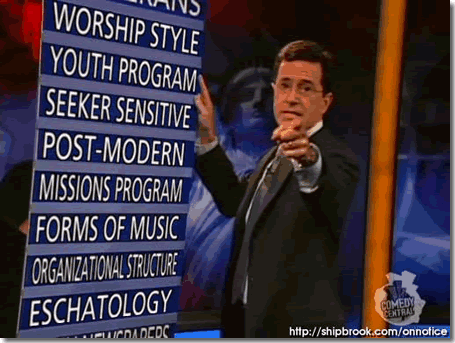
There was also comments like, “The music is to loud.” “Why can’t we sing more hymns.” “Its wrong to have that post-modern group meeting on Sunday night. They should come on Sunday morning like the rest of us.” “The youth program is not satisfying the needs of our family.” These are sincere and blessed people of God talking and I love them, but what they were saying is that their needs and preferences were not being satisfied.
My intent is not to disparage these wonderful people, but to use this experience to illustrate our continued need to shift the thinking of the average follower of Jesus away from our faith communities being a vendor of religious goods and services designed to meet “my needs,” to a people asking “What will it take to transform my community by the power of the gospel?” Not to do so is to become a slave to preference. And if you think this is only a problem with the institutional church, I believe you would be mistaken. I see much the same problem in all types of faith communities including many who consider themselves to be post-modern and/or emerging.
“One of the most important considerations in breaking the [missional] code is to break from our own preferences. Simply put, being missional does not mean doing things the way we like them. It means to take the gospel into the context where we have been called … and to some degree, to let the church take the best shape that it can in order to reach a specific culture. However, the problem is our preferences. You can’t be missional and pick what you like at the same time” (Breaking the Missional code, page 50).
Ed Stetzer says that the key to overcoming “preference slavery” (I love that phrase) is to become a slave to others and refers to Paul’s model given in 1 Corinthians 9:19-23.
As my fundamentalist pastor friend here might say (played by the great John Colbert), “What preference has you enslaved?”
Lord, help me overcome my slavery to my preferences and become a slave to the preferences and culture of others.
I promised John Lunt last week that I would report on our regular day on the street with the homeless and marginalized, but I’ve been remiss in doing so.
Let me first say, it was one of the best times on the street we’ve had with over 40 men and women showing up in need of food and warm clothing. Plus, we had another new family come down and help.
It was a cold day (in the twenties Fahrenheit) and had been for a number of days. Hot minestrone soup was the main course along with salad, rolls, fruit, our regular donation of pastries from Starbuck’s, orange and apple juice, milk and hot coffee.
With cold weather, clothing was in demand and how blessed we were to have lots of stuff. A friend of mine had a contact with a bulk purchasing service that would allow us to buy socks and high quality gloves at less than 70 cents/pair for socks and I think $1.00/pair for ski type gloves. When our Adult Bible Fellowship class from our faith community found out, they took an impromptu collection and raised $212.00. We were able to purchase a large quantity of socks and gloves and this was our first Saturday since they had arrived. Perfect timing. Its so humbling to see the face of a man with blue hands from the cold get a pair of good quality ski gloves.
We also had two large boxes of new thermal underwear (Long Johns) which was a donation from our local Air National Guard unit. This is the stuff the fighter pilots wear! You should have seen the eyes light up when I mention we had them. Also available were blankets, some coats, a few stocking caps, and a couple plastic tarps.
If serving the marginalized was not enough, we also had great opportunities to talk with many of them. Marty was a talkative as ever and many wanted to know who we were and why we were there.
A great day all around and thanks for asking John.
 Our faith community has been working to involve more and more of its member in learning to live the life of God in the way of Jesus, including becoming involved with our community in a variety of ways. One of the many ways this is being done is through our existing small group structure and an eight week study title “What Then Must We Do?” which was written by one of our pastors, Justin Ubel. Now the neat things about this study is that it is not all about more knowledge. As Justin wrote, “[T]he whole purpose of this study is not simply to talk a good game when it comes to following Jesus, but to actually do the things that following Jesus entails.”