Sacred Roots Community in Portland
Wednesday, August 24th, 2011Good things happening at Sacred Roots Community in Portland. Explore this community in this well done eight minute video.
Good things happening at Sacred Roots Community in Portland. Explore this community in this well done eight minute video.
Rain and Shine: Darkest and Brightest Moments in Church Planting – a free Portland event where 14 speakers from 14 different churches with 14 minutes each will talk about church planting.
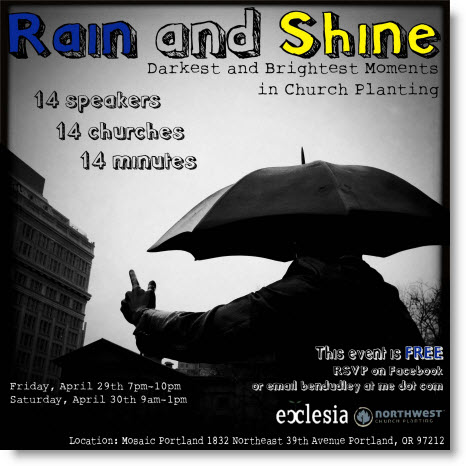
Learn more and RSVP at the events Facebook page: www.facebook.com/event.php?eid=104585102950467.
HT: Bob Hyatt
Portland is a pleasurable, fun, outdoorsy, progressive, pleasant, small town feeling, city. But it does have a real weird side — which is celebrated. Being a passionate Jesus follower in such a cultural context is part of the weirdness.
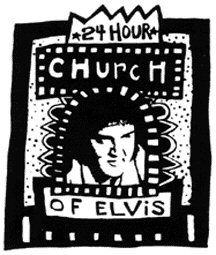
Speaking of spiritual things, whatever happened to Portland’s 24 Hour Church of Elvis? Maybe Oregonian Steve has the lowdown in one of his video reviews of Portland weirdness.
The Barna Group notes that “there is little debate that most Americans are faith-oriented people. Yet how does spirituality and religion differ from one city to the next?” They decided to find out and released some of the results today.
I’m not sure what conclusions one might draw from the survey results, but here are some snippets of their findings:
The lowest share of self-identified Christians inhabited the following markets: San Francisco (68%), Portland, Oregon (71%), Portland, Maine (72%), Seattle (73%), Sacramento (73%), New York (73%), San Diego (75%), Los Angeles (75%), Boston (76%), Phoenix (78%), Miami (78%), Las Vegas (78%), and Denver (78%).
The markets with the largest share of unchurched adults included San Francisco (44% of whom had not been to a religious worship service in the last six months), Portland, Maine (43%), Portland, Oregon (42%), Albany (42%), Boston (40%), Sacramento (40%), Seattle (40%), Spokane (39%), New York (38%), Phoenix (38%), Tucson (37%), and West Palm Beach (37%).
One of the underlying stories is the remarkably resilient and mainstream nature of Christianity in America. Nearly three out of four people call themselves Christians, even among the least ‘Christianized’ cities. Furthermore, a majority of U.S. residents, regardless of location, engage in a church at some level in a typical six-month period.
You can read more here.
 Our urban neighborhood was like many others. People living in isolation with little interaction. It was a residential area, not a community. But we started a neighborhood project a number of years ago that finally got finished and has had brought dramatic positive change.
We lived in an area which had unimproved gravel streets. Since I grew up on a farm, gravel streets was never an issue. But for many in our area they were a problem. Localized basement flooding and street erosion caused by inadequate stormwater drainage from these unimproved streets led many to improvise stormwater systems, as well as creating the need for annual street repair.
Neighbors started to come together looking for a solution. After years of wrangling with the City of Portland’s transportation department (all rules and no vision), we had several neighbors approach Portland’s Bureau of Environmental Services where we found a responsive city agency with vision.
 Since our neighborhood is situated at the headwaters of Stephens Creek, (one of the few streams in southwest Portland that still flows freely to the Willamette River, and contains wetlands) we insisted that the project be environmentally driven. BES responded eagerly with a proposed “Green Street” project.
A “Green Street” is one where the streets are designed to integrate a system of stormwater management within a street’s right of way, reduce the amount of water that is piped directly to streams and rivers, be a visible component of a system of “green infrastructure” that is incorporated into the aesthetics of the community, make the best use of the street tree canopy for stormwater interception as well as temperature mitigation and air quality improvement, and ensures the street has the least impact on its surroundings, particularly at locations where it crosses a stream or other sensitive area (from Wikipedia).
The project was finished this past year, although some wetland work continues.
 Even though this was a neighborhood initiated project, the Bureau of Environmental Services spearheaded the planning and work. The project manages stormwater runoff from a 17-acre basin and includes:
How did our neighborhood benefit? It brought our neighbors together around a common cause which overnight brought down the walls of isolation. We are a community now where we know each other, visit, pick up mail when others are on vacation, children play together and we have even taken some to doctor appointments and other errands. It enhanced the livability of the area, created green space and wildlife habitat (ducks are back and we had a deer walk down the street last week), preserved the maximum number of mature trees, enhanced Stephens Creek, and solved street and flooding issues.
 One other important aspect was our insistence that sidewalks be included. On the very day that the sideways were done, people were out walking and visiting, and it has not stopped. Sidewalks are a key to ensuring that walls of isolation remain down so that relationship building can continue. And as these relationship have matured, we have had many opportunities to verbally share our live and faith as Jesus followers.
Further, because of my activism in this project, I’ve been able to connect with many of our Southwest Portland neighborhood leaders and city officials. This has and is leading to greater community involvement of myself and our faith community in the life and affairs of the local area.
You too can be the catalyst that transforms your neighborhood into a community where you can build relationships as you walk in the way of Jesus. Looks for common ground and get involved. It’s part of the practical outworking of a mission shaped life.
As many of you know, every third Saturday we go down and minister to the homeless. Other Saturdays are taken care of by other teams. We were down today and what a blessing it is and, alternatively, what a painful time. Painful because you can’t help more.
It has been cool and very wet for weeks now and over half of these people have no shelter at night. They are cold and wet and have no place to go. We provide them with a hot meal, socks, companionship, small talk, a listen ear, and often other useful items. Last month I was asking a number of them what kind of things they needed and tarps came up. So I was able to get 10 high quality plastic tarps and take them along today. I wasn’t a dozen feet out of my car when I gave away the last one. They were desperate for some type of shelter from the rain.
I took a couple of pictures today, because they often tell a better story. But I’ll admit that I don’t like doing so because I feel like I’m somehow exploiting their pain and need.
Right after I took these it started raining again, but not too badly.


We can have from 35 to 100 people on any given Saturday. They really are a wonderful group of people.
One of my dreams is to have a day time drop in center for the homeless. This would give them a place to go during the day to stay dry and warm and be safe. Right now it is just that, a dream and it would take a miracle to ever pull it off.




Nice Wee Theme | Powered by
WordPress
Entries (RSS)
and Comments (RSS)
