Building Community

Helped organize a neighborhood event this morning along with the Stephens Creek Stewards and Portland Bureau of Environmental Services. We got a neighborhood work party together to help protect the wetland on our street from Purple Loosestrife and other invasive weeds.

We filled two garden waste recycling containers, saved the City the expense of sending in a crew, create some ownership of our local environment and got to know some of our newer neighbors.

It was another step in bringing a greater sense of community to the neighborhood. At the social hour in our backyard afterwards, I got a good response about doing a block party next year.

Small positive steps in community and relationship building.

Tags:

Down We Go With Kathy Escobar

Kathy EscobarMy friend Sonja Andrews recommended strongly that I read Kathy Escobar’s new book, “Down We Go: Living Into the Wild Ways of Jesus” (Civitas Press, June 2011). Since I highly respect Sonja’s judgment and have been reading Kathy’s blog for years, it was an easy call.

The first thing that grabbed me is that Kathy states her focus in writing the book is for “friends who are tired of talking about God in theory and now just want to do something.”

That’s me and a whole lot of my friends who are on this missional journey. The conversation is good and often needed, but I’ve moved on to living out the life. So anything that speaks to that and helps me along that path is welcome.

In the introduction she write this — and here I think she begins to give us a flavor of her book and the message she wants it to embody:

“I began to see that Jesus doesn’t call us to a life of ascent where we move further and further away from the things of this world. Rather, I believe he calls us to a life of descent, of downward mobility, where we move down into the trenches of real life, real pain, real hope in our own lives and in the lives of others.

“This is in deep contrast to the life of upward mobility that the world — and sometimes the church — beckons us toward. A life of comfort, predictability, and self-protection was never the idea. Jesus embodied downward mobility and calls us to the same.

“To me, downward mobility is a matter of the heart, not financial resources. It is losing our lives instead of protecting them. Giving away our hearts instead of insulating them. Intersecting with pain instead of numbing it out. Entering into relationship with people different from us instead of staying comfortably separated. Learning instead of teaching. Practicing instead of theorizing.”

More as I devourer this tome, but here is a short intro video Kathy did:

Down We Go – Kathy Escobar from Quadrid Productions on Vimeo.

Tags: , ,

Sacred Roots Community in Portland

Good things happening at Sacred Roots Community in Portland. Explore this community in this well done eight minute video.

Tags: , ,

The Radical Middle

In this 11 minute video, Palau Association President Kevin Palau interviews Imago Dei Community Pastor Rick McKinley.

Good discussion on how the holistic gospel doesn’t separate or try to remove or even compartmentalizes, but understands that both proclamation and social justice need each other. They are both part of the embodiment of the gospel.

Rick also talks about the partnership between the churches in Portland and the City of Portland that attempts to embody this shift change.

Tags: , , ,

Where are the Missional Evangelicals?

missional journal

David Dunbar, President, Biblical Seminary, writes his Missional Journal every couple of months and it is always something I make time to read.

This month he asks, “Where are the Missional Evangelicals?”

It’s a good thought provoking read where he first lays out the issue: “The positive and enthusiastic involvement of Evangelicals in the cause of global missions over the last century makes their comparative non-participation in the missional church movement intriguing. I am not saying that the movement is devoid of evangelical voices–that is clearly not the case. But given Evangelicals’ concern for gospel outreach, one might have expected that by now the word “missional” would be more clearly understood, that churches would be more engaged with the opportunities for incarnational ministries, that more Bible colleges and seminaries would be revamping programs in a missional direction, etc. So what’s up?”

Dr. Dunbar suggests that “perhaps a larger problem that has stood in the way of evangelical embrace is that the missional discussion has not seemed sufficiently ‘biblical.’” Now comes the heart of his argument. He writes that this current ambivalence of Evangelicals toward the missional church based on this assertion “is no longer justifiable (if indeed it ever was) in terms of insufficient biblical grounding. The game-changer is (or should be) the thoughtful and detailed work of Christopher Wright, an OT scholar and chair of the Theology Working Group of the Lausanne Movement. His massive study The Mission of God: Unlocking the Bible’s Grand Narrative (IVP, 2006) argued powerfully for the theme of mission as integral to a faithful reading of scripture. He has recently published a very engaging follow-up entitled The Mission of God’s People: A Biblical Theology of the Church’s Mission (Zondervan, 2010).”

He then highlights several points from the books that he found particularly helpful: Mapping the Bible around the mission of God, election, and a holistic or integral mission.

Full text here in a PDF document.

If you don’t get his newsletter, you might give it a go. You can subscribe here and also read archived newsletters.

Tags: , , , ,

Martin Luther King, Jr. Quote

If today’s church does not recapture the sacrificial spirit of the early church, it will lose its authenticity, forfeit the loyalty of millions, and be dismissed as an irrelevant social club with no meaning for the twentieth century. —Martin Luther King, Jr.

HT: Mike Breen


Consumerism in the Church

Love reading Mike Breen. In his post today, “Obituary for the American Church,” he tackles the temptations that are slowly insinuating themselves into everything we call church. They are:

  • A culture of Celebrity (affirmation)
  • A culture of Consumerism (appetite)
  • A culture of Competition (ambition)

It is a good read, but the temptation around consumerism is still, in my opinion, the biggest issue many of our churches face today.

Consumerism in the Church

Here is what Mike has to say about the issue and a question to ponder.

We live in a culture that revolves around consuming. Every TV commercial, every store, every credit card company, every bank, every TV show or movie, every piece of clothing, car or product, every website, every restaurant…every everything is tailored to fit your desires, needs or personal preference. We are easily infuriated when things don’t happen exactly as we want them. We exist in a place that implicitly says this: “We are here to serve you and meet your every whim and desire. Let us take care of you.” What’s more, it’s never enough. Eventually the house or the car get older and we want new ones. The clothes aren’t as fashionable and we want something more in style. That restaurant is getting boring, we must find another. Our favorite TV show is wearing thin, so the search begins for the next favorite. And on and on and on. This is how we are wired to think in the United States. And it is all backed up by this rationale: You’re worth it. You deserve to have what you want, how you want it, when you want it. And for the most part, the church plays the exact same game. We do as best we can to provide as comfortable an experience as humanly possible, using every means at our disposal to attract them in (and then keep them in). So we tailor what we do around their wants and desires. That’s Marketing 101, right? The problem is at the end of the day, the only thing that Jesus is counting is disciples. That’s it. He doesn’t seem to care too much about converts, attendance, budgets or buildings. It’s about disciples. And, by nature, disciples are producers, not consumers. Yet most of our churches are built around feeding consumers. I’d argue 90% of the church’s time, energy and resources are linked to this. But the issue is this: The means you use to attract people to you are usually the means you must use to keep them. In other words, if you use consumerism to attract them to your church, it often means you must continue using it to keep them…or else they will find another church who will meet their “needs.” And yet…that consumer mentality is antithetical to the Gospel and to the call of Discipleship. Disciples aren’t consumers, they are producers. Jesus cared about disciples more than anything else.

Question: In what ways is your church community using consumerism as the means to draw people to a Gospel that is, in and of itself, anti-consumerism?


Wanted: Notorious Leader of an Underground Liberation Movement


Notorious Leader of an Underground Liberation Movement

Wanted for the following charges:

  • Practicing medicine, winemaking and food distribution without a license.
  • Interfering with businessmen in the temple.
  • Associating with known criminals, radicals, subversives, prostitutes and street people.
  • Claiming to have the authority to make people into God’s children.

Appearance: Typical hippie type—long hair, beard, robe, sandals.

Hangs around slum areas, few rich friends, often sneaks out into the desert.

Beware: This man is extremely dangerous. His insidiously inflammatory message is particularly dangerous to young people who haven’t been taught to ignore him yet. He changes men and claims to set them free.

Warning: He is still at large!
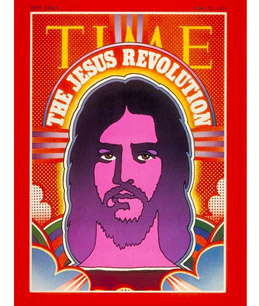

Jesus Movement

These are the opening lines of the June 21, 1971, cover story in Time magazine. It covered the “Jesus Revolution” or as we usually labeled it, “The Jesus Movement.” It was the time when the Spirit moved deeply among the under 30 generation — a generation growing up in “an impersonal and despiritualized life that increasingly finds release in sexploration, status, alcohol and conspicuous consumption.” A world falling apart, being exploited and destroyed, where a “Silent Spring” seems very likely, a world on the “Eve of Destruction.” It was a time when many of us honestly never expected to see our 30th birthday (seriously).

And the Church? Irrelevant, meaningless and sold out to “The Man.”

The Jesus revolution rejects not only the material values of conventional America but the prevailing wisdom of American theology.

Times don’t seem to have changed much, but the Spirit is blowing a refreshing breeze among His people which has again opened spiritual eyes and ignited a movement — the missional movement — where “the way of Jesus” informs and radically transforms our existence to one wholly focused on sacrificially living for Him and others and where we adopt a missionary stance in relation to our culture.

The Jesus Movement faded, but its fruit radically impacted the American church. I expect the missional movement as we know it will also fade, but it too will (and already has) have a radical and deep influence on western Christendom.

Because the Jesus Movement is the root of the missional movement, it is well worth your time to read the full Time magazine story. You can find it here.

Other Relevant Posts

Learning From the Jesus Movement

Living Life As Beautifully As We Can

Another Jesus Freak Called Home


On the Word “Missional”

Alan Hirsch on the word missional.

The word when it describes everything, describes nothing.

If we lose this word, where do we go? What other words do we use to look at the future of the church and how do we recalibrate it?

A Missional Manifesto Released

Missional Manifesto

Around this time last year a number of people were working toward a “Missional Manifesto.” The intent was to say, “This is what we mean when we talk about being missional.” It was not the manifesto’s intent to say this is what everyone should think or say about the term.

For whatever reason, the writing and release of the Manifesto got put off. The entire discussion seemed to have either gone underground or died completely.

Looks like it went underground, because today the core group working on the Manifesto released it. You can read it here and then weigh in with your thoughts and comments on this post, on your own blog, or at other places I’m sure it will be discussed.

Here is a recent video discussion on the Manifesto.

The Exchange May 2011 – The Missional Manifesto with Guest Alan Hirsch from Ed Stetzer on Vimeo.

Tags: , , , , ,