Last week, hiked 29.1 miles over five days into the Mink Lake basin of Oregon’s Three Sisters Wilderness. The three of us on the left have been backpacking together for well over 30 years. Not in our 20′s anymore, but we still love doing the miles.
The Barna Group has spent the last five years exploring the lives of young people who drop out of church. The research provides many insights into the spiritual journeys of teens and young adults and uncovers these five myths:
Myth 1: Most people lose their faith when they leave high school.
Myth 2: Dropping out of church is just a natural part of young adults’ maturation.
Myth 3: College experiences are the key factor that cause people to drop out.
Myth 4: This generation of young Christians is increasingly “biblically illiterate.”
Myth 5: Young people will come back to church like they always do.
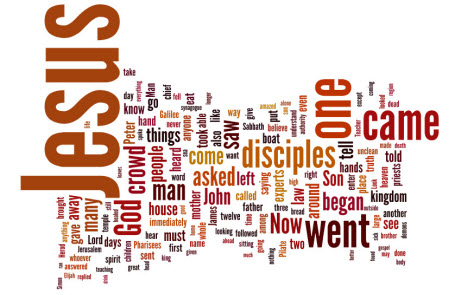
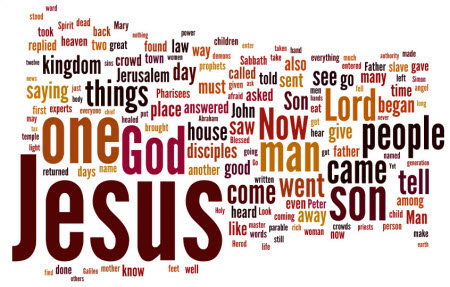
I’m a visual/kinesthetic learner. As a visual learners I learn best by seeing information. So to discover insights into something, I’m always looking for a way to picture information. A word cloud is one way to do this.
A word cloud gives greater prominence to words that appear more frequently in the data being examined. So the more frequent a word appears in the text, the larger it appears in the word cloud. This allows one to quickly see main ideas, subjects or thoughts based on the words used.
I recently created word clouds (below) for the gospel according to Matthew, Mark, Luke and John.
It’s interesting to see commonality, as one would expect, but also the uniqueness of each.
Just finished reading the Pew Research Center’s U.S. Religious Knowledge Survey where they find that atheists, agnostics, Jews and Mormons are among the highest-scoring groups on religious knowledge, outperforming evangelical Protestants, mainline Protestants and Catholics.
Interesting read, but how they can attempt to provide a baseline measurement of how much Americans (quoting them) “know about the beliefs and practices of major religious traditions as well as the role of religion in American history and public life” with just 32 questions is a mystery.
It would seem to me that one would have to ask hundreds of question to get a proper sense of our comprehension of this extensive subject. And my guess is that the scores would be a lot poorer than this 32 question survey reflects.
You can take Pew’s test here to see how you do in comparison with the 3,412 randomly sampled adults in their survey.
I’d be interested in your reaction and thoughts on this survey including whether you see any noteworthy implication in the reality that evangelical Protestants have less religious knowledge than some other groups.
One of the Missional Tribe instigators Brad Sargent (aka futuristguy) brought to my attention a movement called The Seven Mountains.
Here is their guiding premise: “When we [Christians] lose our influence, we lose the culture, and when we lose the culture, we fail to advance the Kingdom of God.”
Now, I find this premise to be extremely disturbing, a completely non-biblical proposition and in opposition to the missional paradigm.
1) Jesus followers do not seek influence or power as The Seven Mountains movement advocates. Missionality is in part about being powerless. Not spiritual powerlessness, but material or temporal powerlessness.
2) We can’t lose something that is not ours. We live in a culture, we don’t possess it.
3) Not saying we don’t play a role, but the last time I check, God advances his kingdom, not us. And it certainly isn’t dependent on the culture one finds themselves in.
Saturday, January 3rd from 8am-4pm Christ Community will be hosting a missional (non)conference in Fort Wayne, IN, called “Seeding Missional Communities: A Learning Commons.” Read more about this non-conference here and here.


 Just finished reading the Pew Research Center’s