Archive for the ‘Orthopraxy’ Category

Kiva Gift Certificate Give Away

Tuesday, October 9th, 2007

I’ve talked about micro-credit lending programs and the positive impact they have on poverty and justice issues. I love the concept and have invested my “loan dollars” through an organization called Kiva. When I started they were little known and had far more loan requests than lenders like myself. This all change recently with the release of Bill Clinton’s new book “Giving” where Kiva is highly touted. They have become known!

You can read a couple of my posts on the subject including, Dr. Yunus, “Banker to the Poor” and Kiva Update.

You can learn more about Kiva here.

I’m so sold on this concept that I’d like to introduce it in a practical way to two people. I’m going to do this by giving away two US$25.00 Kiva gift certificate that two people can use to make their first micro-credit loan through Kiva.

It is open to anyone who reads this blog. The only condition is that you have never used Kiva or any other micro-credit program to make a micro loan and that, if you have a blog, you post on your experience at some point in the future.

If you’d like to be one of the lucky two, just leave a comment on this post. I’m not sure how I’ll decide if I get more than two comments (which I hope I do), but it will be fair, if subjective.

Comment away!

World Carfree Day

Thursday, September 20th, 2007

Image: Car FreeAs their website explains, “World Carfree Day is an annual celebration of cities and public life, free from the noise, stress and pollution of cars. Each year on September 22, people around the world organize events of all sizes to showcase alternatives to the automobile.”

Fran and I have already been limiting our car use and it helped us a lot when we sold our second car. Only having one requires (forces) you to do better planning and to use your feet and/or public transportation. And we are not unique. Data on how people get to work in Portland shows that 13.5% take public transportation, 11% carpool, 5.5% walk and 4.4% bike. That still leaves over 64% driving solo, but that is coming down (down 5.2% in ten years) and is pretty good for a fast growing large metropolitan area.

We are also pretty lucky because of the investment we (the citizens of Portland) have made in public transportation. You wouldn’t believe how easy it is to get around in Portland without a car, so much so that our two boys didn’t get their drivers licenses until they were 19 and 20. They just hopped a bus and off they would go. You can read more in this BBC report on Portland titled, “Where the Car Is Not King.”

Although World Carfree Day is an effort to address global climate change, which is important, for me one of the fundamental changes we see in reduced car usage and increased use of alternatives is the building of compact neighborhood communities that have a high quality of life, lots of community interaction and much of your daily needs can be met with a short walk. Just adding sidewalks in our neighborhood has brought our neighbors out of the backyards and house. Not a day goes by now where I don’t see and talk with a half-dozen of them. Sure is easier to “be missional” in such an environment.

As a side note, the World Carfree Network has chosen Portland as the location for its 2008 conference.

Black Students Sit Beneath the “White Tree”

Thursday, September 13th, 2007

Update (Thanks Brad): “Louisiana Court Overturns Conviction of Black Teen in ‘Jena Six’ Racial Fight Case.” From the new report: “A state appeals court Friday [September 14th] tossed out the aggravated battery conviction that could have sent a black teenager to prison for 15 years in last year’s beating of a white classmate in the racially tense north Louisiana town of Jena.” Read the full article here.

It is appalling to think that after 50+ years of fighting this battle, there are still places in the US where the justice system is used to keep blacks in “their place.”

“Last fall in Jena, the day after two Black high school students sat beneath the ‘white tree’ on their campus, nooses were hung from the tree. When the superintendent dismissed the nooses as a ‘prank,’ more Black students sat under the tree in protest. The District Attorney then came to the school accompanied by the town’s police and demanded that the students end their protest, telling them, ‘I can be your best friend or your worst enemy… I can take away your lives with a stroke of my pen.’

“A series of white-on-black incidents of violence followed, and the DA did nothing. But when a white student was beaten up in a schoolyard fight, the DA responded by charging six black students with attempted murder and conspiracy to commit murder.

“It’s a story that reads like one from the Jim Crow era, when judges, lawyers and all-white juries used the justice system to keep blacks in ‘their place.’ But it’s happening today. The families of these young men are fighting back, but the story has gotten minimal press. Together, we can make sure their story is told and that the Governor of Louisiana intervenes and provides justice for the Jena 6.”

You can make your voice heard for justice at: www.colorofchange.org/jena/?id=2559-212460.

(HT: Bob Hyatt)

Saturday in the Community

Wednesday, August 22nd, 2007

Clothing Giveaway

This past Saturday was a busy one. At 7:30 am I walked over to our building to get ready our annual back-to-school clothing giveaway. When we opened the doors at 8:00 am, we had over 75 low income individuals waiting and our welcome and instructions were given in English, Spanish and Swahili. By the end of my two hour shift, over 200 had come through. Only clean like new or new clothing is given away and there is always more than enough. What is left goes to the Salvation Army. I might also add that this is a joint effort with St. Luke Lutheran a local Presbyterian Church who, on the Saturday before, provides backpacks full of school supplies.

Saturday was also our neighborhood’s annual day long festival called Multnomah Days (Multnomah is a Native American word pronounced Mult-no-mah). We live in Multnomah Village and rarely miss this fun event. My wife suggested to the leadership of our faith community last year that we get involved and we did for the first time Saturday. So, after the “Tails End Dog Parade,” my wife and I took a three hour shift in our booth giving away bottled water and Popsicles. Both my wife and I saw this as a way to push our church out into the community and become involved with the locals. Seemed to go pretty well and leadership is excited about doing it again next year.

Kiva Update

Wednesday, July 11th, 2007

I’ve posted on my experience with micro-lending through Kiva in the past including here.

I started my loan portfolio in October 2006 with the plan of adding a small amount of new money each month and making a new loan or two from that amount. At some point, loans would begin to be repaid. When they did, I’d roll those funds back into new loans instead of adding new funds. At some point my hope is that no new funds will be needed.

Well, in June and July some of my first loans were paid off and so I didn’t have to add any new funds in those two month. A number of other loans are getting close to being paid back, so there may not be to much need for additional dollar, which will help my budget :-).

According to Kiva, here is what my loan portfolio looks like:

————————————-

Portfolio Distribution

Gender
Female 68.8%
Male 31.3%
Country
Ecuador 43.8%
Kenya 12.5%
Nigeria 6.3%
Togo 6.3%
Afghanistan 6.3%
Bulgaria 6.3%
Mozambique 6.3%
Ghana 6.3%
Honduras 6.3%
Sector
Retail 31.3%
Food 31.3%
Clothing 18.8%
Agriculture 12.5%
Services 6.3%

————————————-

If you haven’t looked into micro-lending as one way to help reduce world poverty, please do check it out by clicking on the Kiva banner in the right hand column.

American Perspectives on Poverty

Saturday, June 30th, 2007

Over the past forty years, federal statistics have pegged the poverty level in the 12% to 15% range. Currently, the estimate is about 13%. The Barna Group has just published its research regarding American attitudes and perspectives on poverty. Here are some highlights.

Three out of four adults (72%) consider poverty to be one of the most serious social problems facing the United States today. That includes one out of every five adults (21%) who contend that poverty is the single, most serious social problem of all. Just 4% argue that poverty is not much of a problem in the U.S. Evangelical Christians were only half as likely (11%) as the rest of the adult population to deem poverty to be the nation’s most vexing social challenge. Asian Americans (11%) were similarly less likely to see the issue in this way.

Two-thirds of Americans (64%) consider poverty to be an issue that the government is primarily responsible for addressing. Nearly one out of five people (18%) say it is the primary responsibility of each individual citizen to address poverty. Much smaller numbers of people say it is the duty of churches (4%), non-profit organizations (4%) or businesses (3%) to take the lead on dealing with poverty.

Evangelicals were among the groups least likely to see poverty as a job for the government (55%) and were the group most likely to see it as a matter for churches to address (14%). The only other group that was similar was “Christian Revolutionaries” — a Barna phase for people who indicate that their highest priority in life is living for God and who possess a worldview that is based on biblical principles. Barely half of the Revolutionaries (52%) assigned poverty primarily to government agencies, while 11% said it was predominantly a church responsibility.

A substantial majority of adults engage in multiple personal responses to poverty, atheists and agnostics emerged as the segment of people least likely to do anything in response to poverty. They were less likely to engage in eight of the nine specific responses measured, and were the faith segment least likely to participate in eight of the nine responses evaluated.

How do you react to these findings?
How can we get more Jesus followers to understand that this is matter for faith communities should be involved with?

Small Town Missional Impact

Thursday, June 14th, 2007

Man do I like reading Chuck Warnock at Amicus Dei. His posts are always thoughtful, challenging and get at the heart of what it means to be missional. Plus, he is in the middle of some pretty cool things God is pulling off in his community.

Chuck has just documented his missional journey with God and Chatham Baptist Church in a recent Leadership Journal (Spring 2007) article that has been posted by Christianity Today titled Learn to Partner. Every small town pastor should read this article and ask God to open partnering opportunities in your area.

And if you don’t have Chuck’s blog in your RSS reader, add it now. You will be encouraged.

Update June 19th: Just found that Chuck has another site called Confessions of A Small-Church Pastor. Good stuff.

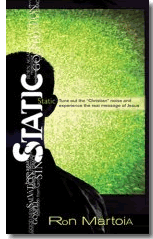
Static

Tuesday, May 29th, 2007

“The Ooze” Select Blogger Book Review

“Static” by Ron Martoia (Tyndale, 2007) is one of those books that will speak to the person who already knows the truth the author is working to relate and to those who have never explored this ground. For the former, it will refresh and invigorate the concepts. For the latter, it will open a whole new door of understanding.

So what is this book about? Its about how the words many Jesus followers use to describe their faith often shuts down spiritual conversation instead of enhancing it. Our language creates ‘static’ and the author want us to learn to tune out the ‘Christian noise’ so both the Jesus follower and the not-yet-Christian can experience the real message of Jesus.

Although the style used in the book to communicate the message is not my favorite approach, it is effective. It takes the form of an ongoing dialog between the author and Jess and her husband Phil. Phil has been “sharing” with a Marty, a coworker. Seems Marty is now avoiding Phil and Phil can’t figure out why.

In the 241 pages, Martoia does a tremendous job exploring the language Phil and most Jesus followers use when talking with not-yet-Christians. Ron attempts to answer questions like “Why do people tune out the Christian message? Why are the words we use turning people off from the real message of Jesus? What if these words are causing misunderstandings about Jesus? What if we haven’t heard the whole story?”

To give you a taste, let me leave you with this line of thought from the book.

Martoia asks, “How many people do you know today who go around with feelings of guilt over their sin, over missed obligations, over offending God?”

Most people in our post Christian western world who are not followers of Jesus simply find no connection with the idea that they are sinners in need of a savior and therefore don’t connect with our “gospel.” “That doesn’t mean they are accurate in their self-assessment, but it does explain why they have moved on to other conversations,” say Martoia. Further, the author explains why Jesus dying on the cross for our sins so that we can go to heaven doesn’t even reflect the story that people in the first century would have understood when explaining the word gospel.

What’s the answer? You’ll have to read the book, but as Chuck Smith Jr. writes, Martoia guides “us back through original language in its original setting [and] brings us to a gospel that is a divine newsflash, as compelling today as it was in the first century.”

For those who read and enjoy Scot McKnight, you will also like this book. You can hear the echo of Scot throughout, who, not surprising, Ron credits as a major influencer.

Highly recommend.

Any of you read this book yet? If so, what was your take?

Earth Day 2007

Friday, April 20th, 2007

Earth Day is Sunday, April 22nd.

I’ve been creating a list of things a faith community can do to reduce its environmental footprint with the hope of getting some of them implemented at my faith community.

  • Plant more native trees on the property owned by the church to reduce carbon dioxide in the atmosphere.
  • If available from your electrical utility, switch to Green Energy.
  • Replace light bulbs and other lighting with recommended energy saving ones.
  • When replacing kitchen and office applicants and equipment, purchase energy efficient models.
  • Reduce or eliminate the use of chemicals in the maintenance of the property grounds and landscape.
  • Modify the properties landscape to one that uses natives and requires no supplemental watering.
  • Effectively recycle office and classroom waste.
  • Use recycled cardboard coffee cups instead of polystyrene.
  • Using environmentally sustainable office supplies, such as: recycled copy paper and non-toxic cleaning supplies.
  • Contact your local utility and ask them to perform a church energy audit, Implement its recommendations.
  • Encourage people who can to bike or walk to your Sunday gatherings.

I’d love to hear what other specific steps can be taken. Got some thoughts or suggestions?

God’s beautiful earth will not be saved by words or good intentions. It will be saved by humble, anonymous acts like turning off the lights, hanging clothing on the line, bicycling to work, and planting trees. —J. Matthew Sleeth

John Smulo Update

Wednesday, April 18th, 2007

Just a quick update and a big thanks for all who responded to my post about the Smulo family financial need. John has posted a couple times at his blog about the encouragement and love they have felt as a result of those who reached out to them, so I’ll not repeat any of that here.

I just wanted to let you know that John emailed me tonight and said that they had received a total of US$1,800 from people in the USA, Canada, England. What an profound sense of wonder it is to see others reach out to a hurting brother, and in an amount far greater than I thought possible.

We did more than just tell John and his family, “Go in peace, be warmed and filled,” we helped give them the things needed to meet basic needs.

Thanks again!