Archive for the ‘Books’ Category

Fred Peatross, Building a Culture of Missional Christians

Wednesday, March 21st, 2007
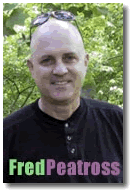
Fred Peatross ImageFred Peatross, Conversational Editor at New Wineskins magazine, describes himself as one who makes “ordinary attempts” to evangelize through relational acts of kindness and enjoys praying behind his friends’ backs as he journeys with them as a spiritual explorer and sometimes guide. He avidly creates safe-places for the not-yet-Christian. He has missional in his DNA and he is on a missional mission.

Fred is currently in the middle of writing a series of booklets that relate to emerging-missional church. These are more “why-to” than “how-to” handbooks.

In explaining his motivation for doing this series, Fred said,

My vision is the building of a culture of missional Xians. Unlike Frost & Hirsch, I still have hope, though faint, for the established churches in turning from attractional to missional. And even though we have created a generation of consumer Xians, many practice works that could be characterized as evangelistic.

With that said there are two important things that must be accomplished: To educated Xians on the fact that evangelism is as much process as it is event and being in the lives of people at the different turning points on life’s continuum makes a difference. Second, intentionality must replace apathy and “spectatorship.”

If things are going to change the established church must create the space for change to happen. Hence, the suggestion of replacing the traditional adult bible class for missional training.

So through this series of booklets I’m expressing my vision.

There are currently four guides out:

  • Shine Like Stars: In a Post-Enlightenment World — As the late Keith Green says in one of his songs, “We’re asleep in the light” and Jesus commands us to go. It’s not a choice whether or not we want to be missionaries.
  • Moderation or Abstinence: Liberty or Law — “The realization that our views on drinking alcohol have been influenced more by cultural trends of the 1800’s than a rigorous examination of the Scriptures comes as a shock to many of us.” —Andrew Jones
  • Evolution of an Emerging — Where is this all going? Will the emerging conversation become a movement or remain just a phenomenon?
  • Some Say We Need a Revolution: I Say Revolution — Offers the established church a mechanism for making the transition from attractional to missional.

Here is a quote from Some Say We Need a Revolution: I Say Revolution:

[Missional] training should emphasize the development and momentum to resist the centripetal attraction of exclusive, self-obsessed Christian fellowship. To sustain a centrifugal ministry it will require a commitment to mission–a holistic way of being Christian, a culture, a lifestyle that is comfortable functioning without the regular weekly church structure, that is able to draw on a diffuse set of spiritual resources, that is innovative and creative in generating community and in providing mutual support. At the very heart of it all must be an instinctive enthusiasm for developing a ‘cross border’ spirituality. This will require both patience and time.

You can find out more about Fred and his guides by going to his blog, Abductive Columns.

Dr. Yunus, “Banker to the Poor”

Tuesday, March 6th, 2007

I’ve just finished Dr. Muhammad Yunus’s book, “Banker to the Poor.” For those who don’t know Dr. Yunus, he is an economist who founded the Grameen Bank, which pioneered micro-credit lending programs for Bangladesh poor, especially women. For his work with Grameen Bank he won the 2006 Nobel Peace Prize.

The over 270 pages is broken into 14 very readable chapters. The first couple deal with Dr. Yunus’s childhood through his college years in America on a Fulbright scholarship. But the majority of the book deals directly with his awaking to the plight of what he calls the hard-core or absolute poor, his initial attempt to help (lending $27.00 of his own money to 42 people), his first regional project which eventually led to the founding of the Grameen Bank.

It seems like a simple solution that Dr. Yunus hit upon, but there have been and continue to be many structural obstacles. He writes, “In both rich and poor countries alike, credit institutions have favored the rich and in so doing have pronounced a death sentence on the poor. Why have economists remained silent while banks rejected the poor as unworthy of credit? Nobody can provide a convincing answer. Because of this silence and indifference, banks have imposed a financial apartheid and gotten away with it. If economists would only recognize the powerful socioeconomic implications of credit, they might recognize the need to promote credit as a human right.”

I really think micro-lending is a powerful tool for good and justice and Dr. Yunus’s story and work is worth leading about. In reading this book you will learn some important insights and gain a unique perspective on the poor and their willingness to work.

Kiva Update

To put feet to my belief, I joined Kiva (Kiva.org) last fall and started funding micro-loans through their network. Since I can’t afford to put a large amount into loans up front, I’ve been funding a small amount each month. I just did my March funding and now have loans to 11 individuals. Eight have started repayments and two are over 50% paid off.

I’m curious to hear from others who know about or participate a micro-lending scheme.

  • What has been your experience?
  • Who do you work through to make or fund loans?
  • Any downsides or cautions others should know about?

Dan Kimball on “I Like Jesus … Not the Church”

Wednesday, February 28th, 2007

They Like Jesus, But not the ChurchI’ve just started to read Dan Kimball’s new book, “They Like Jesus, but Not the Church” (Zondervan, 2007) and I can already tell that I’m going to have a hard time putting it down. Dan is also going to be in Portland on March 14th as part of the George Fox University “Ministry in Contemporary Culture Seminar” series. If Dan is as good in person as he is in print, this should be a great presentation.

So I was taking a few minutes away from Kimball’s book to answer some email, reply to blog comments and check my RSS feed, and what do I see but a mention that Dan has written an article titled “I Like Jesus … Not the Church” for Outreach magazine (March/April 2007). You can read the article here. They also provide a link to a lengthy excerpt from “They Like Jesus but Not the Church.”

Here is the opening summary to Dan article:

Today’s non-Christian 20- and 30-somethings are big fans of Jesus but are less thrilled with His followers and the churches where they worship. Pastor/author Dan Kimball reveals their six most common perceptions of Christians and the Church, what they wish church was like–and why you should be listening to these emerging voices.

Here are the six most common perceptions of the Church among post-Christian 20- and 30-somethings which Dan deals with in the article and book.

1) The Church is an organized religion with a political agenda.
2) The Church is judgmental and negative.
3) The Church is dominated by males and oppresses females.
4) The Church is homophobic.
5) The Church arrogantly claims all other religions are wrong.
6) The Church is full of fundamentalists who take the whole Bible literally.

I’m sure the book is going to give me some good blogging material, but don’t wait to read it hear, go out and buy a copy.

Alan Hirsch Radio Interview

Monday, February 26th, 2007

A great a radio interview with Alan Hirsch, author of “The Forgotten Ways.”

Books That Have Made a Difference

Wednesday, January 10th, 2007

Books. Fifty thousand new ones are published every year, but few sell more than a couple hundred copies and fewer yet impact the life of the reader in any meaningful way. But, once in a while a book comes along that God uses in a profound way to mold us and change us.


I’ve often thought it would be interesting to start of list of those books which have made that type of difference in my spiritual pilgrimage. Not just any book mind you, but the few that dramatically changed my understanding and direction in life. Those that God used to make me who I am today. A start on that list is below.

What this list is not is a recommendation that you read them so you to can have a deep transforming experience with God. Its not likely to happen because my context is different than yours. You will note also that many of the titles are old. That’s because I’m old and my spiritual formational time was during the 70s and 80s. Still, there are some real classics in the list. Here goes.

  • Hal Lindsey’s “The Late Great Planet Earth” (Zondervan, 1970). This might seem like an odd book to lead off the list, but you have to know the context of the late 60s and early 70s. It was a pessimistic time when most of us thought we’d be lucky to live to see our 30th birthday. Not because of Christ’s second coming (although we did expect it soon), but because if we didn’t died in Vietnam, then surely a nuclear war between the USA and the USSR would end life pretty much as we knew it. It was also a time of a great movement the Spirit through my generation that we now call the Jesus Movement. Personally, God used this book to stir-up and rekindle in me a desire for him which had been dormant for many years. It started the journey and just goes to show you that God can use bad theology and strange ideas.
  • Anything by Andrew Murray, particularly “The Spirit of Christ” (Bethany House, 1979) and “With Christ in the School of Prayer” (Revell, 1953). “The Spirit of Christ” is one of his classic works on the relationship between the believer and the Holy Spirit. The dust cover of “With Christ in the School of Prayer” says, “Here are Christ’s teachings on the secret of believing in prayer, the certainty of answered prayer, the power of prevailing prayer, and the chief end of prayer.” It truly does. My copy is dated 1953 and cost $1.50 at the used book store.
  • Anything by A.W. Tozer. Leonard Ravenhill said of Tozer, “I fear that we shall never see another Tozer. Men like him are not college-bred but Spirit-taught.” “The Pursuit of God” and “The Knowledge of the Holy” are great works.
  • One of the first book studies I ever did was on Job and J. Allen Blair’s “Living Patiently” (Loizeaux Brothers, 1966) was my guide. It is not a theological book, but a devotional study and helped me learn a lot about the importance of a patient, trusting relationship with a God who cares.
  • Man do I love D. Martyn Lloyd-Jones and his “Studies in the Sermon on the Mount” (Eerdmans, 1977). What he unfolded for me in those pages was both deeply stirring and enriching and strongly taught that life is a journey and a pilgrimage of dependence on God. My copy of his “Joy Unspeakable” (Shaw, 1984) about the power and renewal in the Holy Spirit is also well worn.
  • Ron Sider’s “Rich Christians in an Age of Hunger” (Word, 1977) and Tom Sine’s “The Mustard Seed Conspiracy” (Word, 1981) greatly influence my perspective on a Christian life that is not a life of greed and acquisitiveness.
  • Howard Snyder’s “The Problem of Wine Skins: Church Structure in a Technological Age” (Inter-Varsity, 1975) is a noteworthy 1975 book that deals with how evangelical churches have drifted away from the biblical pattern and the drift has been towards lifelessness and ineffectiveness. Ray Stedman said of this book, “[It] exposes the dimensions of this drift and calls the churches back to love, power and simplicity.” And you thought all that stuff the emerging church talks about was new.
  • “The Independent Scholar’s Handbook” (Addison-Wesley, 1983) by Ronald Gross was the required text for a college marketing class I took in the early 80s. It taught me a very powerful lesson on how to turn an interest in any subject into expertise and how to make that expertise available to others. Life changing and taught me a lot about intentionality.
  • Back in the early or mid 80s when Henry Blackaby was still a pastor and missionary in British Columbia, our church invited him to conduct a weekend long teaching time for the leadership. What a profound, I’ll never to be the same again, weekend that was. Henry taught what would be refined and published later as “Experiencing God: Knowing and Doing the Will of God” (Lifeway Press, 1990) which has sold over 3,000,000 copies. When I read his “Hearing God’s Voice” (Broadman & Holman, 2002) a couple of years back, it was like I was transported back to that weekend. Good, good stuff.
  • My spirit just burned within me as I read Jim Cymbala’s “Fresh Wind, Fresh Fire” (Zondervan, 1997) a few years back. It was subtitled, what happens when God’s spirit invades the hearts of his people. It really brought me back to the necessity for a complete and absolute dependence on God in all we do.

I’d sure be interested in hearing about a book that impacted your life and how.

P.S. Yes, the bible is THE BOOK, but that is not what were talking about here, so please don’t chase that rabbit.