Archive for the ‘Books’ Category

Reggie McNeal on Attractional and Missional

Tuesday, March 17th, 2009

Reggie McNeal looks the attractional model and how it differs from the missional paradigm.

I’ve have been tweeting other quotes via twitter.

The attractional model of church creates a ‘member culture,’ in which people join a particular church and support that organization with their attendance, their money, their prayers, and their talent. The flow is toward the church, which is always at the center of the action, where the big game is being played.

The missional church is made up of missionaries, who are playing the big game every day. They live their lives with the idea that they are on a mission trip. On mission trips, people focus on the work of God around them, alert to the Spirit’s prompting, usually serving people in very tangible ways, often in way that involve some sacrifice or even discomfort. Life on mission is more intentional and more integrated. While the concerns of life (family, work, leisure) are pursued, they are part of a larger story being played out for the missionary.

The member culture views society as a series of silos: politics, business, education, arts, media, technology, health care, social sector, and so forth. All of them are separate. The church culture has developed its own silo — a parallel culture in many respects — complete with schools, businesses, educational institutions, health care facilities, sports clubs, travel associations, and social agencies. Positioned as one silo among others, the church works to recruit people and resources from the other domains, vying for attention and money…. Its activities serve effectively to take a lamp and put it under a bushel.

The missional church views the church’s position in society very differently. It understands that God has his people — his missionaries — deployed across all domains of culture. After all, since the mission is redemptive and the world is God’s target, doesn’t it make sense that he would take this approach? Otherwise, how would salt be distributed or light puncture the darkness?

Quotes from Reggie McNeal’s “Missional Renaissance” (Jossey-Bass, February 2009), page 54 & 55.

Book Review: Under the Overpass

Tuesday, March 3rd, 2009

Image: Under the OverpassA book review of Mike Yankoski’s “Under the Overpass: A Journey of Faith on the Streets of America.”

* Paperback: 224 pages
* Publisher: Multnomah Books (March 2005)
* Language: English
* ISBN-10: 1590524020
* Available on both the Sony Reader and Kindle.

I love this book. Read it from cover-to-cover in less than 72 hours. It is about two twenty-something Jesus followers (Mike Yankoski and Sam Purvis) who spend five months on the streets of six difference American cities as homeless men. They “went from upper-middle class plush to scum-of-the-earth repulsive overnight.”

As the publisher writes, it is a story about faith, identifying with the poor and discovering more “forgotten, ruined, beautiful people than we ever imagined existed.” But it is also an examination of how other Jesus followers reacted to them “from complete rejection and contempt to wonderful acts of love.” But this is NOT a book of condemnation, but of challenge, appraisal and encouragement.

Here are just two of the many stories.

When another guy walked upstairs, he, too, went to the far side of the room and plunked down his tray. On it I noticed a meatball sub and a worn brown leather New Testament. Soon all five, obviously strangers to each other, were busy eating their sandwiches.

“I [Mike] pretended to be reading a book, and Sam did the same, but the aroma of that meatball sub was killing us.

“After a couple of minutes, one of them asked the man with the Bible what translation it was.

“NIV,” he answered. “What version do you read?”

“NLT,” the guy answered.

“Really?” the girl from the other table chimed in. “I really like the NASB.”

“I guess it’s a matter of preference,” the guy in the middle said, taking another bite of his juicy meatball sub. The next ten minutes were filled with lively conversation between the five new friends. Across the room, Sam and I sat quietly, reading and reeking.

“Eventually the five ate their fill and crumpled up their wrappers. Getting ready to leave, the man with the Bible told both couples he would pray for them. Both couples thanked him honestly and said the same thing in reply. As they walked past us, Sam and I looked up trying to catch their eyes and nod a hello. But they carefully looked away. Each emptied their tray of garbage into the trash can next to Sam and turned to walk down the stairs.

“I remembered many times I had walked past a homeless man or woman sitting on the cold sidewalk, awkwardly averting my eyes and whistling to cover my discomfort. I wondered if those men and women had been as frustrated with me as I now was with the people who were walking down the stairs.” (78-79)

Then there is the story about a man named Rings. A kindhearted old chain smoking Jesus follower who lived in the cab of his pickup truck. Rings said he’d been told by God to feed the homeless.

Over the next minutes, Rings told us about his personal feeding program and invited us to help him out the next day”.

The next morning Rings said, “Well, boys like I told you, you’re the answer to my prayers. I got a check yesterday, and my coolers are all empty in the back of my truck. When we finish our coffee, we’ll go to the store and buy enough food to cook up a feast. The [homeless] folks down at the park will be speechless!

“The last thought gave him so much obvious pleasure, he started to laugh, and that led to more coughing, and eventually to more cursing.

“I was impressed that a guy living in a truck cab would consistently give his entire (measly) government check to feed others in similar straits. Most homeless people we’d met blew their checks on booze and drugs within a couple of days.

“I gave him time to regain his composure. ‘Rings, who are you, really?’ I asked.

“I’m just a man,” Rings said with a wink. “Jesus saved me. Been a trucker, a carnie, a door-to-door salesman, a husband, a father. I’ve been in jail, been an addict, been a drunk. Now I follow Christ. All that I have is His. If He can save me, He can save anybody.

“We asked him to tell us more, but rings had other plans. ‘It’s been a crazy road, that’s for sure,’ he said. ‘But come on—the road up ahead is always better than the road behind. Let’s get started.’

“We walked out to his battered pickup, piled in, and drove off to a nearby supermarket. There we bought a hundred dollars worth of eggs, milk, orange juice, pancake mix, steak, tortillas, and butter. Then we headed for the beach”[where] Rings fed twenty or so that day out of the back of his truck. And what a sight that was, too. Hungry, forgotten people stood around in a circle in the foggy morning air watching an old man hunched over his propane stove cooking and smoking, cooking and smoking. I don’t think an eye ever left the chef’s hands as he worked”.”

“When the tailgate feast was ready, and the first man stepped up to take his plate, rings had a speech ready.

“Do you know why I do this?” he asked his attentive audience. “I do this because Christ pulled me out of the mess I was in. then He told me to do this. You want to be free? This is freedom! Enjoy!

“And breakfast was served.” (201-204)

Great read for any Jesus follower and particularly those working with our friends on the streets. And yes, it will challenge you to see these people differently.

More Information

Under the Overpass website.

At Amazon.
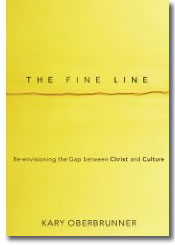
Book Review: The Fine Line

Tuesday, February 17th, 2009

The Fine Line: Re-envisioning the Gap between Christ and Culture
By Kary Oberbrunner, Zondervan, January 2009

Image: The Fine LineThe question Kary attempts to answer is, “Why are so many from this generation voting on spiritual matters with their absence?” He writes that, “Perhaps it has something to do with the fact that there is little difference between the attitudes and actions of believers and unbelievers. Rather than drawing people to Christ, many Christians are pushing people away because of the disconnection between what we say and how we live.” (20)

Why is this? To get at the answer, he suggests that Jesus followers have divided and reassembled themselves into two main camps, the Separatist and the Conformist.

“The first camp separates itself from people, society, and culture in order to stay “˜unstained.’ They turn God’s commands, plus hundreds of other rules and laws, into a heavy burden that supposedly grants personal holiness”¦. They judge others in light of their self-made religion. They’re laced with fear: fear of sinning, fear of compromising, fear of enjoying anything. These people make up the Separatist camp.” (22)

“The second camp conforms itself to the ideals and philosophies of the world. They value what the world values and worship what it worships. They’re a cookie-cutter cutout of pop culture. Attempting to be all things to all people and to enjoy what God has created,”¦ These people make up the Conformist camp.” (22)

These seem to be pretty “black and white” and therefore make for a dangerous over simplification. My experience is that most Jesus followers, although they may lean towards one or the other, are far more complex and can’t be pushed to one of these two extremes. But I suppose it is a helpful foil.

After spending several chapters exploring each of the two camps, Kary suggest an alternative: the Transformists.

“Transformists are the alternative, the exception, the remnant. Transformists are people in paradox, people living in the World but not of the world. Their lives are characterized by balance and relevance.

““¦Unlike Separatists who embrace only Christianity or Conformists who embrace only culture, Transformists embrace both.

“Transformists actually invite tension because they know that where there’s tension, there’s life and growth. But most importantly, where there’s growth, there’s Jesus. By inviting tension, we invite Jesus.” (111)

Transformists, explains Oberbrunner, struggle to balance Christianity with culture and loving God with loving people. This to him is the way we as Jesus followers become relevant to our context and culture.

In the remainder of the book Kary explores the world the Transformists lives in and how they move and interact with it.

For those who have been on the missional journey for some time, you aren’t going to find any new thoughts. But you will find a helpful framework for understanding the concept and a good reminder of what an incarnational life should resemble. It is a quick and enjoyable read.

If you are new to the missional journey, this would be a good and instructive book to read. You’ll learn how to live in the world but not be of it and why it is so powerful and transformative.

Additional Resources

Kary Oberbrunner’s Blog
Book Review at Church Marketing Sucks
Ed Stetzer Interview with Kary Oberbrunner

Is the Science vs. Religion Debate Over?

Thursday, October 23rd, 2008

“The Ooze” Select Blogger Book Review

Is the Science vs. Religion Debate Over? From the number of new books coming across my desk this year, it doesn’t look like it is over. I’ve had three just in recently including “Thank God for Evolution!” by Michael Dowd (Viking Adult, 2008) and “Nature’s Witness, How Evolution Can Inspire Faith” by Daniel M. Harrell (Abingdon Press, 2008) which is part of Emergent Village’s Living Theology series.

Thank God for Evolution!

Here is how the publisher describes this book:

“Thank God for Evolution! presents in a lively and accessible manner the reasons why it is now possible to view evolution as a divine process; how current science shows that evolution is not meaningless blind chance; practical methods for using evolutionary insights to achieve greater personal fulfillment and thriving relationships; and how aligning with evolutionary trends can guide activists and others hoping to make our world a better place. As a Christian minister, Dowd especially addresses the concerns that Christians have about evolution, but this book contains insights that will appeal to people of all faiths and of no faith.”

Nature’s Witness, How Evolution Can Inspire Faith

Whan asked what the author hoped people would gain from this work, he said, “Written as a pastor and practitioner, the intent is to provide scientific information and theological reflection making a connection between faith and evolution reliable, comprehensible, authentic and less fearful.”

Regarding his motivation behind writing the book, he noted, “Theological integrity demands that whatever we think about faith and life correspond to the way things actually are as opposed to how we want or wish things to be. God is the God of reality. If evolution is real, then to reject it presents difficulties for Christian faith and theology. A proposed alternative is to assume that ultimate truth resides in the heart and mind of God and to assume evolution to be part of that truth (‘all truth is God’s truth’). Based upon confirmed scientific data, a flourishing, robust Christianity stays faithful to the Biblical narrative as its source for theological reflection, while at the same time heralding scientific discovery as an accurate description of the universe on which theology reflects.”

If you are wanting to hear about Evolution from a Christian perspective, you should find these two works helpful.

I’m not interested in a debate over Creation/Intelligent Design vs. Evolution, so please don’t start one in the comments section. I bring these two works to your attention in the spirit of fairness and balance.

For those interested in my position, I’m a six day creationist to the core.

More on The Shack

Tuesday, July 29th, 2008

Derek Keefe’s “overview” of The Shack called Reading in Good Faith has been getting some buzz.

Keefe brings some needed balance to the conversation.

Jesus is Not a CEO

Thursday, May 22nd, 2008

Chris Blumhofer writes a needed corrective at Out of Ur on the trend to make Jesus the greatest CEO of all time.

Reading the Gospels for leadership principles like team building, vision casting, or ‘seeing the potential in others’ makes a mockery of authorial intent and historical-cultural backgrounds. Such readings appear to take the Bible seriously, but they don’t do it justice; they simply create anachronistic interpretations.

People need to stop using the Bible to justify their church-as-business paradigm. Chris correctly observes that Jesus was not first-and-foremost a leader with a message for us, but rather a savior who loved the world enough to die for it. He was consumed with the idea of servanthood. If leaders want to follow Jesus example, they too should be servants.

New Books in the Mail

Thursday, January 10th, 2008

Book ImageTwo books arrived in the mail yesterday. They were free review copies that came as part of my participation in “The Ooze Select Blogger Book Review” group.

The first is Brian Sanders’ “Life After Church” (Inter-Varsity Press, 2007). Eddie Gibbs writes, “There is a growing awareness of the extent of the ‘back door’ problem facing many churches. It is often assumed that church leavers represent either the disgruntled transferring to other churches or those who have abandoned their Christian faith. In reality, many are leaving churches out of disillusionment and frustration to continue their spiritual pilgrimage. Brian Sanders tackles this important topic with a clear, analytical mind. He identifies the complex process of leaving a church, and suggests practical ways it can be done in a responsible manner. Most important of all, he argues that leaving must lead to a fresh vision and renewed commitment to Christ, community and the kingdom of God.”

A full book report after I get “Life After Church” read.

Book ImageThe second is a new bible called “The Books of the Bible” (International Bible Society, 2007). This is a narrative type bible which uses the “Today’s New International Version” as its base. Many different literary forms are found in the Bible and if we don’t read the different books in the literary form intended, misunderstanding and distortion of meaning can follow. “‘The Books of the Bible’ seeks…to present each of the books of the Bible in their distinctive literary forms and structures.” Specifically:
  • Chapter and verse numbers have been removed.
  • Books are presented according to the internal divisions that the editors believe the authors intended.
  • A single-column format is used to present the text clearly and naturally.
  • Footnotes, section headings and other supplementary material has been removed.
  • Individual books that later tradition divided into two or more books are made whole again.
  • Books have been placed in an order that the editors hope will help readers understand them better.

My understanding is that the IBS is making this an affordable version at only US$8.95.

More later.

Praying Advent with the Gospel of John

Saturday, November 24th, 2007

Congratulations to Brother Maynard on his new book, That You Might Believe: Praying Advent with the Gospel of John. Learn more here. I’ll be ordering mine shortly.

Faithful to Ordinary Moments and Places

Monday, October 22nd, 2007

“The Ooze” Select Blogger Book Review

Glenn Packiam of the group Desperation Band and associate worship pastor at New Life Church in Colorado Springs has written an interesting book titled Butterfly in Brazil (Tyndale House, 2007).

The title comes from a question posed by MIT meteorologist Edward Lorenz regarding French mathematician Henri Poincare suggestion that “small difference in the initial positions may lead to enormous differences in the final phenomena.” Lorenz’s question was, “If a butterfly flaps its wings in Brazil, does it cause a tornado in Texas?”

Packiam builds on this question by suggesting that one can create lasting change when you start small. To quote Packiam, “To be conduits of change, we must be faithful stewards of the small, ordinary moments.” That is a powerful insight. It is so easy to get overwhelmed by the dream or frustrated by the possible that we never redeem the small ordinary moments God gives us.

The author further suggests that not only does “creating lasting change and achieving big goals [come as the result of the] consequences of a series of smaller actions…. But…widespread change is the eventual consequence of actions done in a particular place.” Change is local. “We may have a grand vision of what God has called us to do, but the next step is always to ask him, ‘Lord, what do I do right here?’ Don’t wait for the ‘somewhere out there.’ Don’t wait for a different platform or a different opportunity. What are the platforms and opportunities within your sphere of influence right now?”

Packiam also intimates that, because lasting change unfolds gradually, it is important that we learn to be faithful over the long haul. To stay the course even in the darkness and despair.

He sums up by saying, “Be faithful with the small things, Act where you are. Stay over the long haul. Multiply your efforts. Love people passionately and personally. Lay down your life in obedience to Christ. These are the marks a life remembered by God, a life that will make a world of difference.”

Not a bad read and the message of small, local, and being in it for the long haul is spot on. That is how to live in a way that matters, that can really change the world.

The Shack

Monday, September 24th, 2007

“The Ooze” Select Blogger Book Review

When bad things happen in your life, do you ever think God has intentionally brought or allowed them to occur and that you deserved it?

Do you ever imagine God in terms of a hard old white haired man who is ready to disciple us (the Father), the loving son who loves us and keep the Father from being too hard on us (Jesus) and the ethereal and unknowing “person” who seems to have no mind of his own (the Spirit)?

Ever ask, “Where is God in a world so filled with unspeakable pain?”

I’ve thought those thoughts and asked those questions and a million more. Well so has William P. Young (he goes by his middle name, Paul) and The Shack (Windblown Media, 2007) is a novel that communicates many of the answers that he has discovered in his 50 year plus life journey.

The Storyline

Mackenzie Allen Philips’ youngest daughter, Missy, has been abducted during a family vacation and evidence that she may have been brutally murdered is found in an abandoned shack deep in the Oregon wilderness. Four years later in the midst of the pain and darkness that has taken over his life as a result of losing Missy, Mackenzie receives an apparent note from God which reads,

Mackenzie,

It’s been a while. I’ve missed you.

I’ll be at the shack next weekend if you want to get together.

Papa

Against his better judgment he arrives at the shack on a wintry afternoon and walks back into his darkest nightmare. What he finds there changes his world forever.

To be honest, most Christian fiction is pretty poor and I avoid it. So I didn’t start reading this novel with much of a positive expectation, but what a pleasant surprise. When I’d have to put it down to do other things, I couldn’t wait to get back to it. I dog eared and marked lots of page. I simply loved Young’s portrayal of the triune God and his understanding that God loves the process and we are in process because He loves us.

One word of caution. If you need doctrinal purity or require that every theological point touched must to be biblically perfect, you may struggle reading this work. You have to remember that it is not scripture, it is a story intended to communicates some very abstract concepts. And I think he does it pretty well.

Who is Paul Young?

In his own words, “Overall, I am a very simple guy; I have one wife, six kids, two daughter-in-laws and two grandkids on the way. I work as a general manager, janitor and inside sales guy for a friend who owns a small manufacturers rep company in Milwaukie, Oregon, and I live in a small rented house in Gresham, Oregon, that Kim has made into a marvelous home. My time is spent loving the people that are a part of my life. I am not connected, or a part, or a member of, or involved inside any sort of organization or movement anywhere. The truth is that I doubt anyone would want me. From my perspective that is a very positive thing — for both of us. I have lots of incredible friends — Oh yeah — and I wrote this book.”

What Others Have Said

Here is what Eugene Peterson says about The Shack, “When the imagination of a writer and the passion of a theologian cross-fertilize the result is a novel on the order of The Shack. This book has the potential to do for our generation what John Bunyan’s Pilgrim’s Progress did for his. It’s that good!”

And from Jordyn Foster, a 12 year old, “This is my most favorite book that I have ever read.”

From around the blogosphere: Internetmonk, Emergent Voyageurs, What’s In My Head, Pilgrimguide, and My Emerging Faith.

Paul blogs at Wind Rumors.

You can hear an interview with the author here although you will have to listen to some non-relevant discussion at the first, but wait for it because it is a good interview.

Any of you read this book yet? If so, share your reaction and comments.