Walter Winchell Quote
Thursday, November 10th, 2011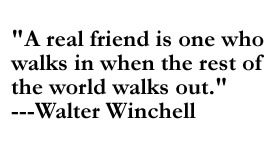
If today’s church does not recapture the sacrificial spirit of the early church, it will lose its authenticity, forfeit the loyalty of millions, and be dismissed as an irrelevant social club with no meaning for the twentieth century. —Martin Luther King, Jr.
HT: Mike Breen
Alan Hirsch on the word missional.
The word when it describes everything, describes nothing.
If we lose this word, where do we go? What other words do we use to look at the future of the church and how do we recalibrate it?
I’m really keen on and deeply value the insights that Reggie McNeal brings to the missional conversation. For me, he gets to the heart of the change that must occur within the North American church.
Here he talks about the three major developments that need to take place in order for the church to undergo a missional transformation.
First, we must move from an internal to an external focus. The church does not exist for itself. When it thinks it does, we’ve created a church-centric world. Our perception of reality is skewed. By external focus of ministry I mean we radically reorient to understand that we exist primarily to do ministry beyond ourselves.
Second, we need to move from a program-driven agenda to a people-development agenda. Over time, the North American church has largely become a collection of programs run by staff or lay leaders. While we will certainly continue to have these programs, I believe a new, people-development agenda will base its sense of accomplishment on how well its people are doing, not its programs. If you start with people, the programs then serve the people, not the other way around.
The third shift is really a leadership response to the other two. It will require that leaders move from a maintenance or institutional model of leadership to a personal model—a ‘movement model’ of leadership. Leading a movement is very different from leading an organization.
If you have read his book, “Missional Renaissance: Changing the Scorecard for the Church,” these are familiar themes. Themes that are at the core of missional transformation and, for this reason, need to be heard often.
And the key is his third point — leadership. If the process doesn’t start with a transformation of our model of leadership within the church, the first two shifts have little hope of taking place. Reggie spends 27 pages in Missional Renaissance covering this leadership shift, so if you want to explore it in depth you may want to pick up the book.
“Strolling through a pine forest, viewing rock formations, and cascading waterfalls, pausing to ponder the quiet surface of the lake and shoreline—little by little we are encouraged to lay aside the chaos of a troubled world and gently nurture the capacity within to hear a more harmonious, universal rhythm. We exchange burden, boredom and despair for renewal, inspiration and hope.”—Hoichi Kurisu
As a result of the U.S. healthcare debate and vote, there has been a lot of Jesus follower jumping in on one side or the other of the issue. Although I disagree with Greg Boyd on a number of topics, I believe he captures the heart of what our view towards politics and political positions should be.
The political system will always try to lure us into believing that our particular way of doing politics is the ‘Christian’ way and tempt us into placing our trust in (what we think is) the wisdom and righteousness of our political positions rather than in the power of self-sacrificial love.
When Christians begin to think this way, it inevitably divides the church, since the ambiguity of politics is such that on most issues, good and decent people can and do disagree. If I naively pronounce that my views are the ‘Christian’ views, then your views must be judged to be ‘un-Christian’ if they disagree with me. This is arrogant and naive. It’s also unbiblical. Jesus called both Matthew, a tax collector, and Simon, a Zealot, to be his disciples. Tax collectors and zealots were at opposite sides of the political spectrum in the first century. Yet we don’t read a word in the Gospels about whose views Jesus thought were most correct, for the Kingdom he came to establish is “not of this world” (Jn. 18:36).
Even more importantly, when followers of Jesus get co-opted by the political system it distracts us from the Kingdom work we’re called to do. To the extent that we place our trust in exercising power over others, we stop trusting our mandate to exercise power under others through sacrificial service. Paul warns us not to get too involved in the affairs of the world, including its politics, but to always focus on pleasing our commander (2 Tim. 2:4)…. We who follow Jesus must always remember we belong to a radically different country with a radically different King who offers radically different solutions to the problems of life. We are missionaries in whatever earthly kingdom we happen to find ourselves in. We are citizens of heaven before we’re citizens of any earthly kingdom (Phil. 3:20).
My prayer is that as followers of Jesus our discussion around the healthcare issue or any political dialogue will be tempered by what Mr. Boyd shares.
Christopher Hitchens was in Portland recently for a speaking engagement. Unitarian minister Marilyn Sewell interviewed him for a local publication, Portland Monthly. The interview was pretty much what one would expect, but I did find the following a fascinating observation from Hitchens:
Sewell: The religion you cite in your book is generally the fundamentalist faith of various kinds. I’m a liberal Christian, and I don’t take the stories from the scripture literally. I don’t believe in the doctrine of atonement (that Jesus died for our sins, for example). Do you make and distinction between fundamentalist faith and liberal religion?
Hitchens: I would say that if you don’t believe that Jesus of Nazareth was the Christ and Messiah, and that he rose again from the dead and by his sacrifice our sins are forgiven, you’re really not in any meaningful sense a Christian.
Much of our difficulty as seeking Christians stems from our unwillingness to take God as He is and adjust our lives accordingly. We insist upon trying to modify Him and bring Him nearer to our own image. —A. W. Tozer
Jesus said whatever you do to the least of these my brothers you’ve done it to me. And this is what I’ve come to think. That if I want to identify fully with Jesus Christ, who I claim to be my savior and Lord, the best way that I can do that is to identify with the poor. This I know will go against the teachings of all the popular evangelical preachers. But they’re just wrong. They’re not bad, they’re just wrong. Christianity is not about building an absolutely secure little niche in the world where you can live with your perfect little wife and your perfect little children in a beautiful little house where you have no gays or minority groups anywhere near you. Christianity is about learning to love like Jesus loved and Jesus loved the poor and Jesus loved the broken. —Rich Mullins
Reggie McNeal looks the attractional model and how it differs from the missional paradigm.
I’ve have been tweeting other quotes via twitter.
The attractional model of church creates a ‘member culture,’ in which people join a particular church and support that organization with their attendance, their money, their prayers, and their talent. The flow is toward the church, which is always at the center of the action, where the big game is being played.
The missional church is made up of missionaries, who are playing the big game every day. They live their lives with the idea that they are on a mission trip. On mission trips, people focus on the work of God around them, alert to the Spirit’s prompting, usually serving people in very tangible ways, often in way that involve some sacrifice or even discomfort. Life on mission is more intentional and more integrated. While the concerns of life (family, work, leisure) are pursued, they are part of a larger story being played out for the missionary.
The member culture views society as a series of silos: politics, business, education, arts, media, technology, health care, social sector, and so forth. All of them are separate. The church culture has developed its own silo — a parallel culture in many respects — complete with schools, businesses, educational institutions, health care facilities, sports clubs, travel associations, and social agencies. Positioned as one silo among others, the church works to recruit people and resources from the other domains, vying for attention and money…. Its activities serve effectively to take a lamp and put it under a bushel.
The missional church views the church’s position in society very differently. It understands that God has his people — his missionaries — deployed across all domains of culture. After all, since the mission is redemptive and the world is God’s target, doesn’t it make sense that he would take this approach? Otherwise, how would salt be distributed or light puncture the darkness?
Quotes from Reggie McNeal’s “Missional Renaissance” (Jossey-Bass, February 2009), page 54 & 55.




Nice Wee Theme | Powered by
WordPress
Entries (RSS)
and Comments (RSS)
